Not a PDF
A site, with a URL
Filterable maps, a sortable aspect table, an etymology explorer with the competing theories side by side. It is hosted permanently and it works on a phone at a funeral.
Your name is not a label. It is four or five words in three or four dead languages, handed down a chain of people who mostly did not choose them. Cairn takes a full name and a birth minute and returns a sourced briefing: every morpheme, every documented record, the ports and counties in between, and the sky overhead — as a permanent interactive site, not a PDF you lose.
The free reading is instant and needs no birth data. Full briefings start at $39.
Filterable maps, a sortable aspect table, an etymology explorer with the competing theories side by side. It is hosted permanently and it works on a phone at a funeral.
The chart is one of eight sections. The other seven are linguistics and archival research — what the names mean, where they were spoken, and which of your ancestors we can actually document.
Every factual claim carries a source link. Every interpretive claim is marked as tradition. Where the scholarship disagrees, we print the disagreement instead of picking the prettier answer.
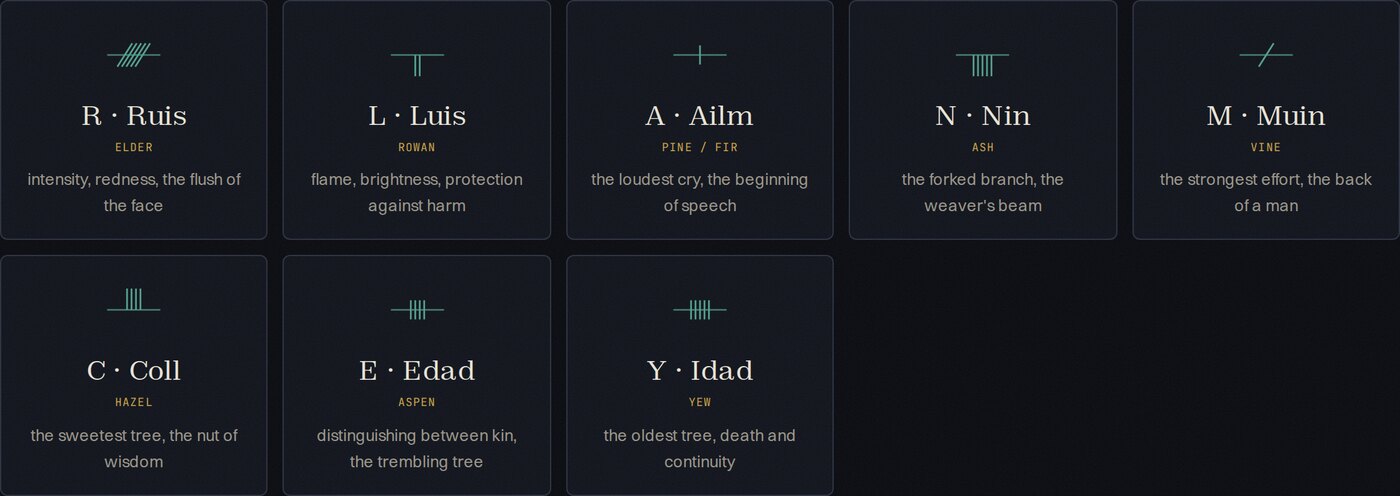
Every name in a briefing is also cut in Ogham, letter by letter, in the four aicmi: the B-group below the stem, the H-group above, the M-group across it, the vowels straight through. Drawn as real geometry from the letter values, because there is no dependable web font for the block.
Both numerological systems with the arithmetic printed, the per-letter tradition, and the name cut in Ogham stroke by stroke with the tree kenning for every letter. Computed in your browser, in about a second, for any name you like — yours, a grandparent’s, a stranger’s.
It is free because it costs nothing to make. Numerology and Ogham are deterministic — the same letters always give the same answer — so a script does it exactly, and charging for arithmetic would be a con.
What costs money is what a script cannot do: sourcing the etymology of each name, computing a real ephemeris, and putting a researcher into county records for the specific people you name.
Numerology, Ogham and tarot material is interpretive tradition with its sources named — not prediction, not advice.
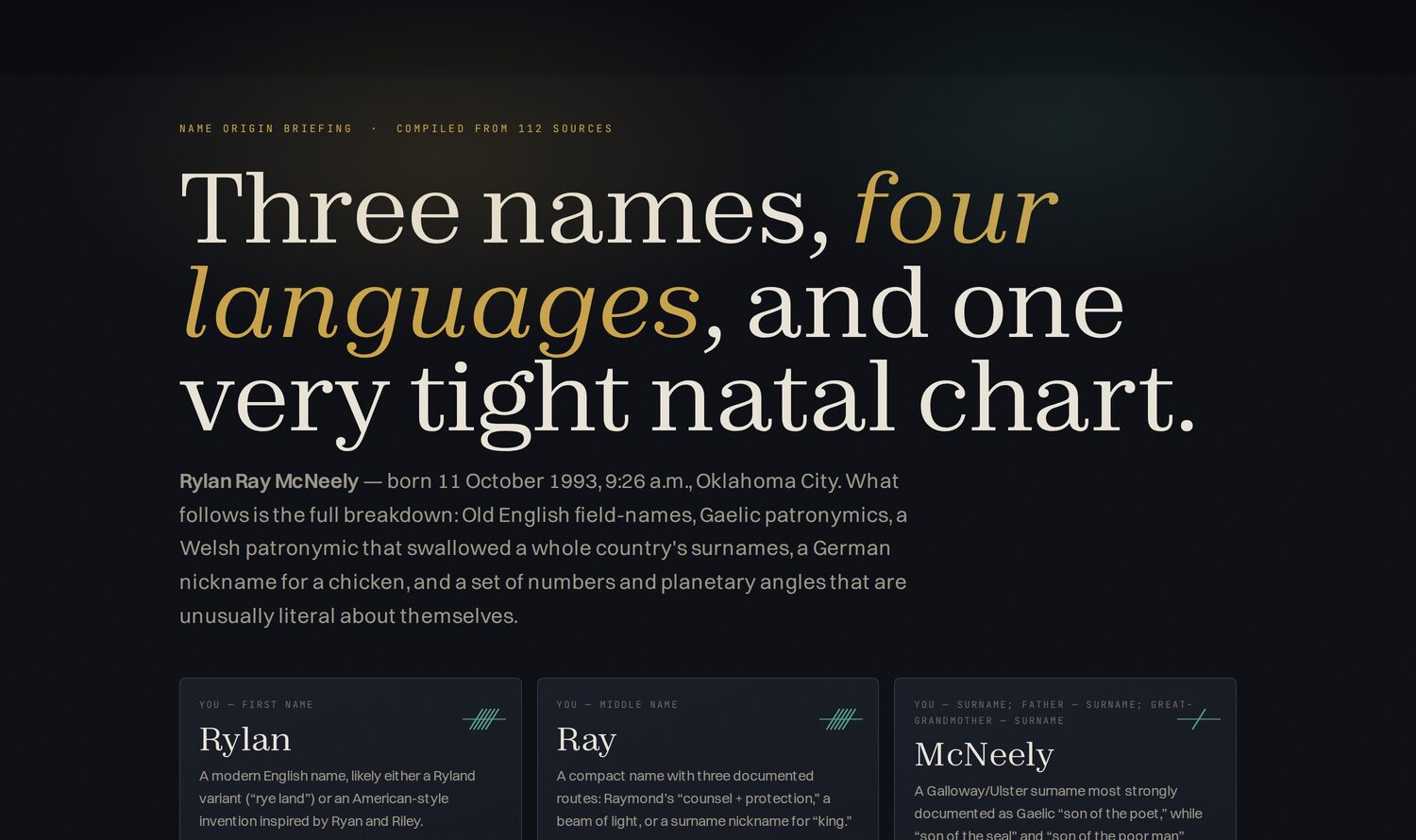
The screenshots below are from a delivered briefing — Rylan Ray McNeely, Oklahoma City, thirteen names across four generations. Nothing is mocked up.
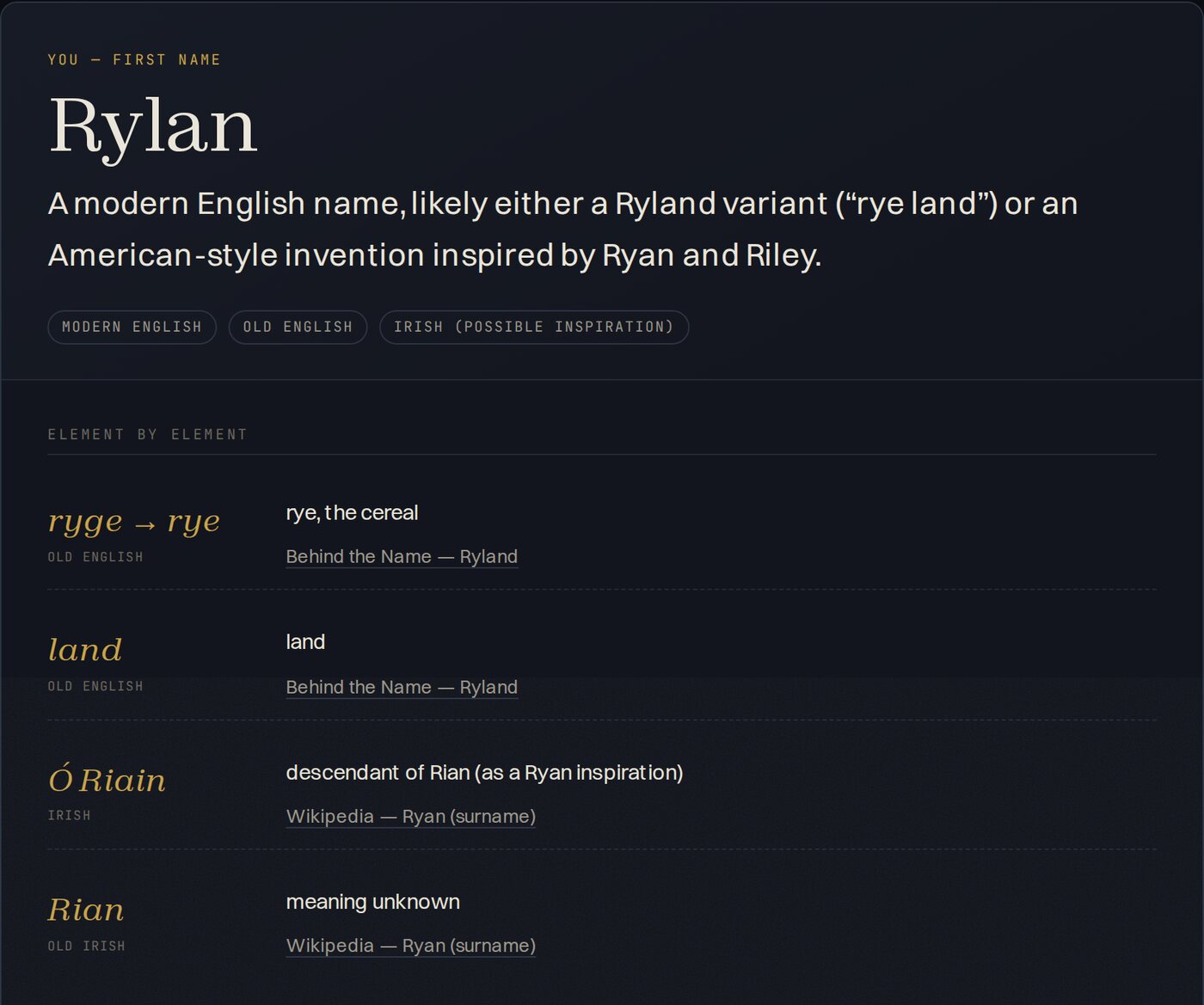
Not “Irish, means strong.” Each name is split into its actual elements, each element glossed and sourced separately, with the competing scholarly readings ranked and the folk etymology explicitly rejected.
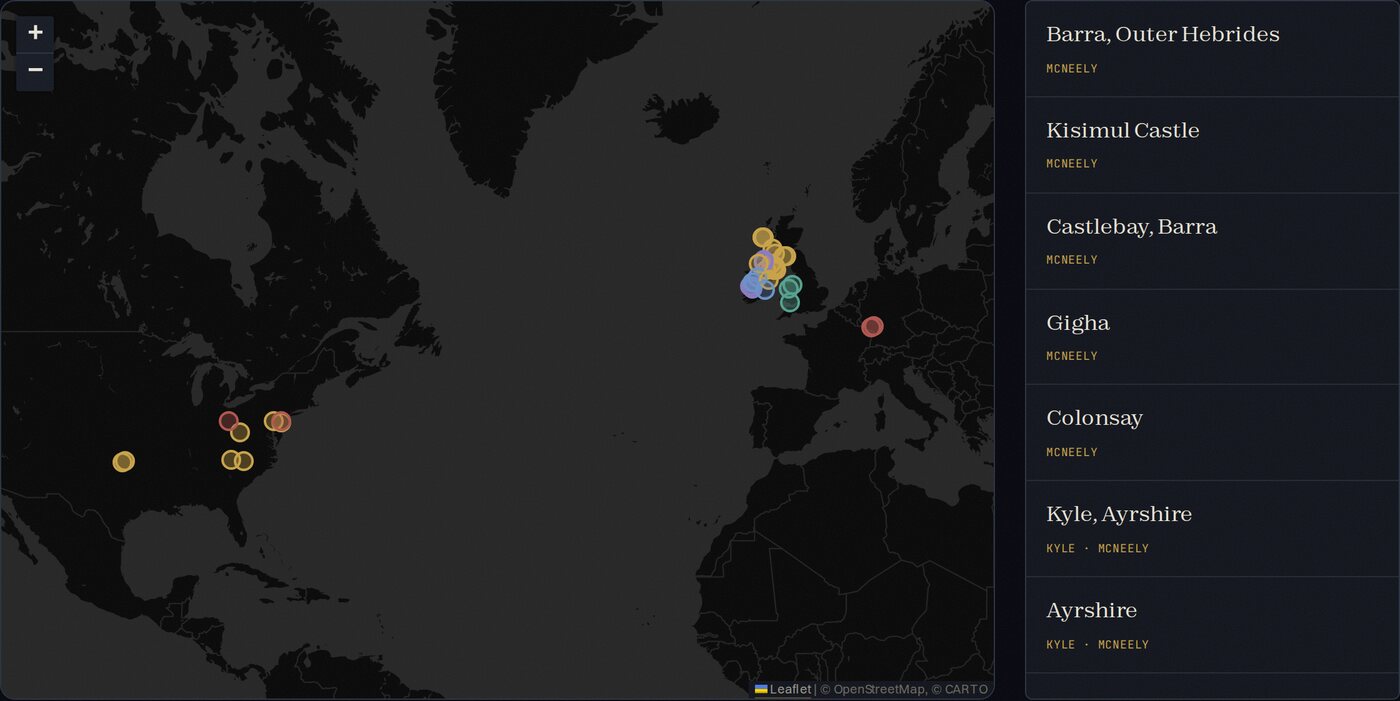
Every clan seat, parish, emigration port and settlement corridor attached to the surname lines, plotted and filterable by line. The point of the map is how little the lines overlap until they all arrive in North America.
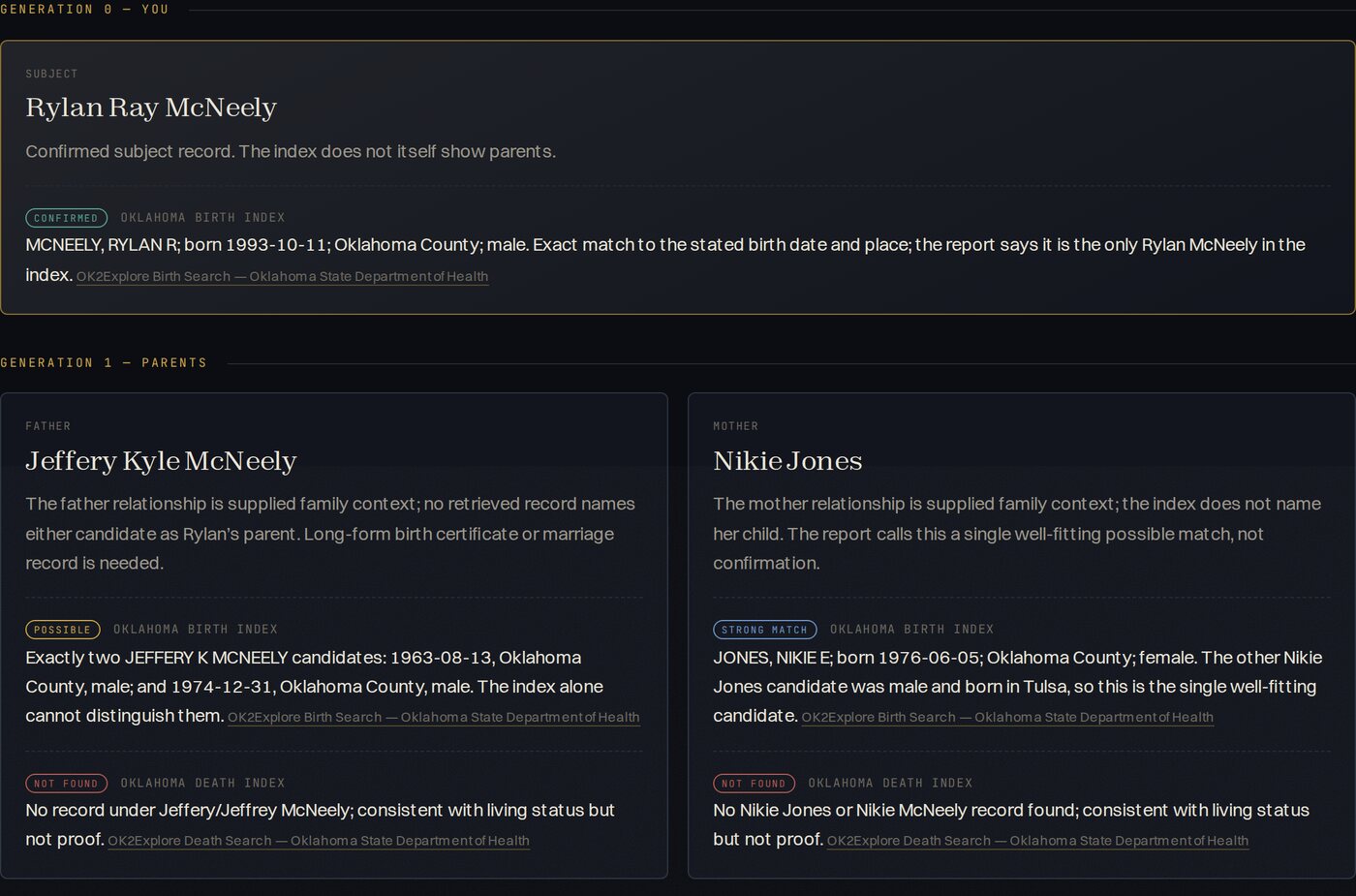
Your tree as you give it, checked against public indexes and then labelled honestly. A confirmed exact match and a plausible name collision do not get the same badge, and a person we cannot find is printed as not found.
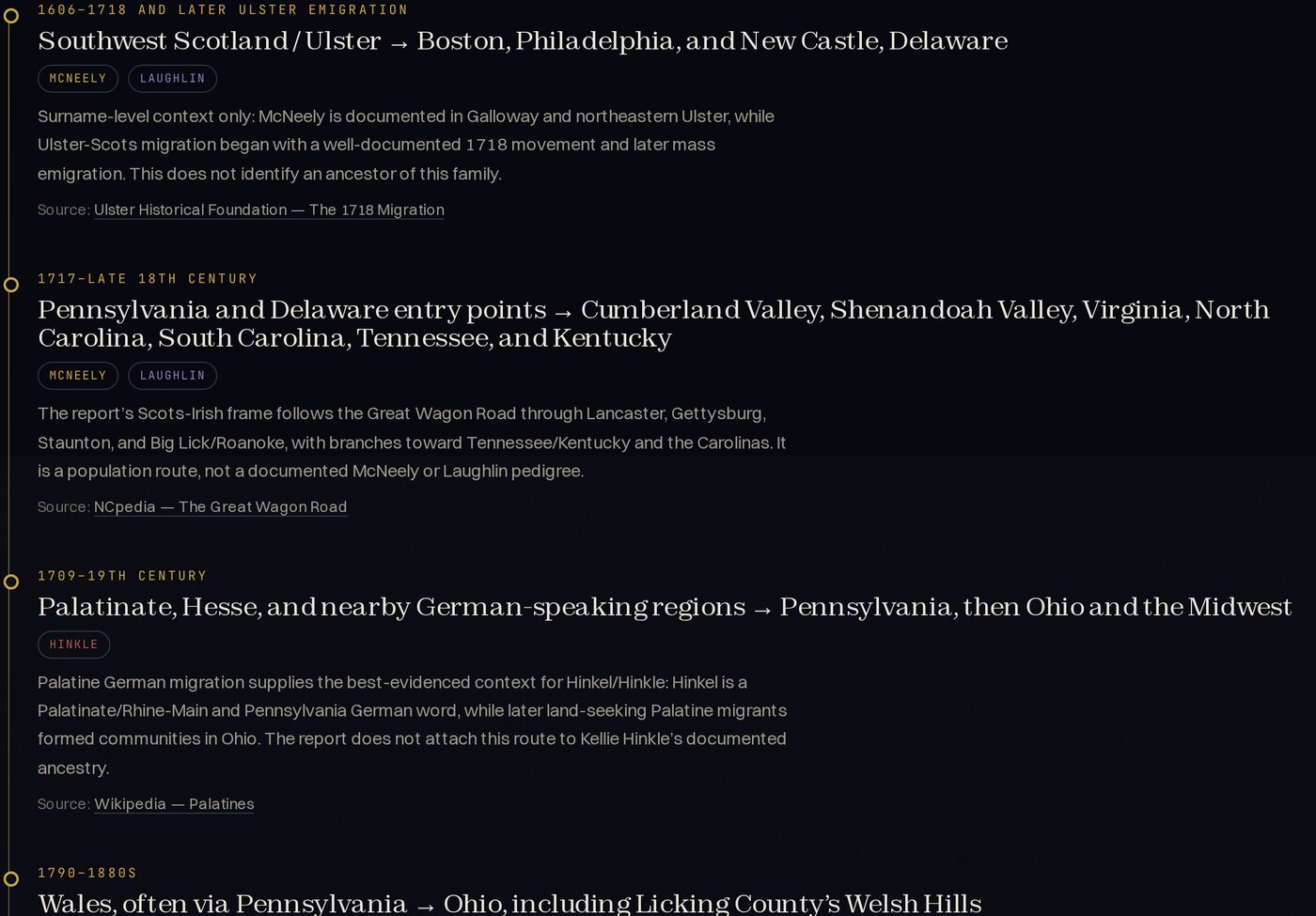
A dated timeline from the Ulster plantation of 1606 and the Scots-Irish sailings of 1717 through the Palatine German arrivals, the Welsh line, and the land runs that put four unrelated families inside the same Oklahoma township before 1907.
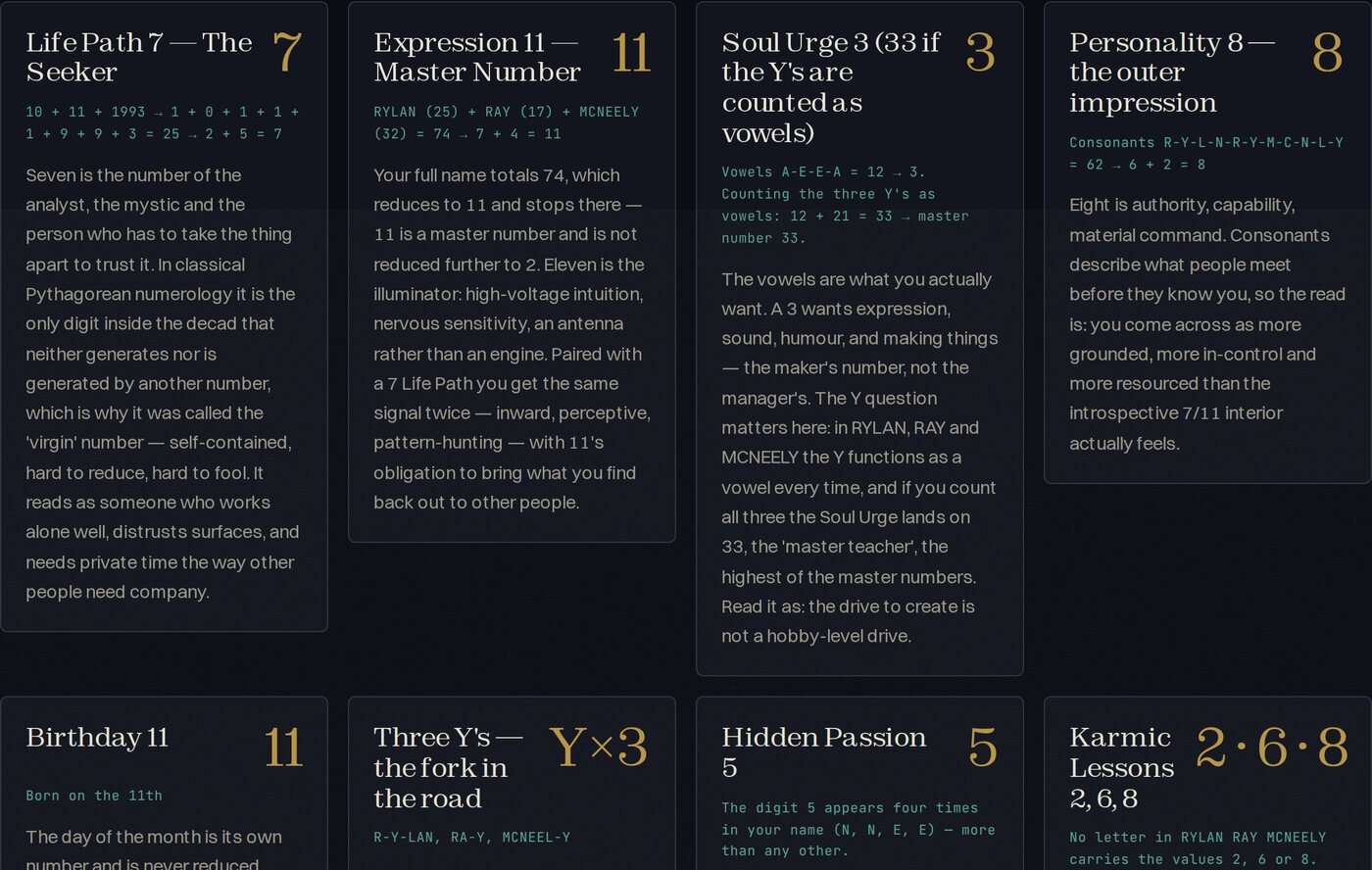
Pythagorean throughout with a Chaldean cross-check, every reduction printed as a sum you can verify. Where the two systems disagree — and on a name with three Y’s they will — both figures are given rather than averaged into mush.
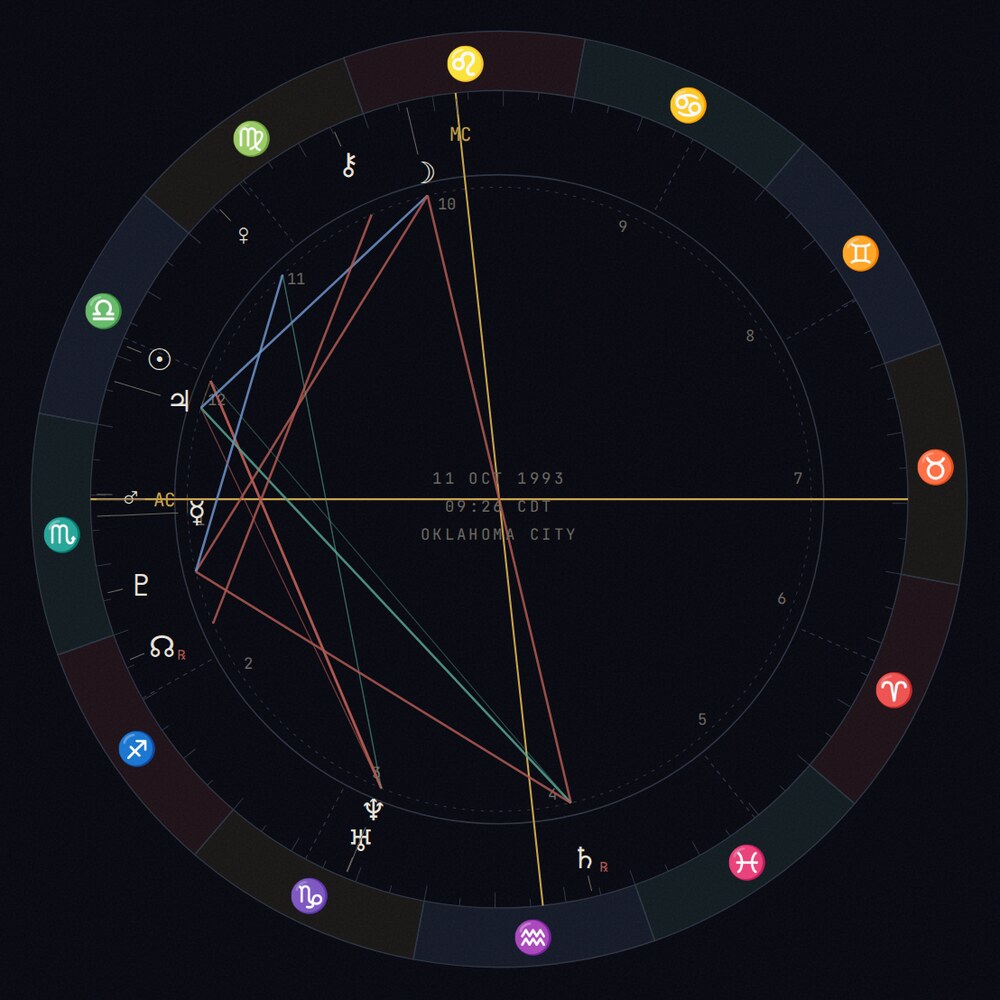
Positions from the Swiss Ephemeris for the exact minute and coordinates, Placidus houses, tropical zodiac. Rendered as an inked SVG wheel rather than a screenshot of somebody else’s software, with aspects listed tightest first and every orb given to two decimals.
Cornerstone and capstone letters, the whole name cut in Ogham with each letter’s tree and its Bríatharogam kenning, and the Major Arcana your figures correspond to. Presented as a symbolic system with its sources named, and never as a claim about the world.
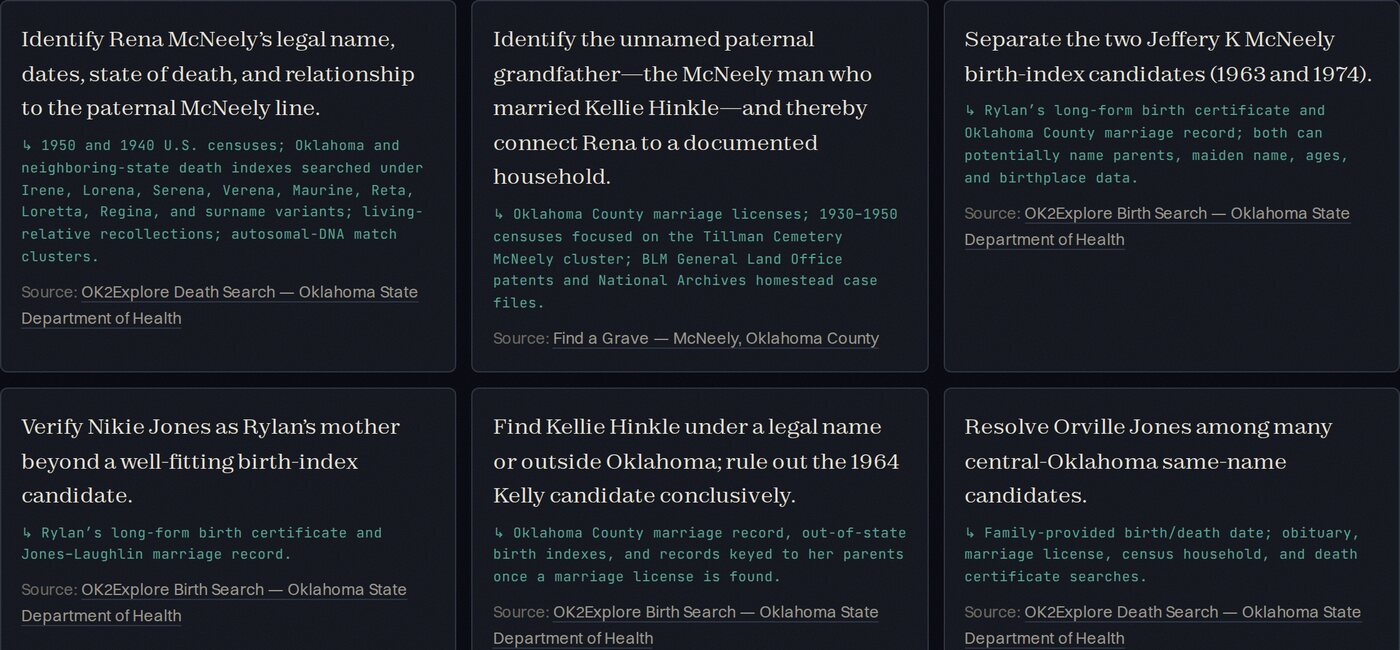
The section nobody else ships. Every open thread is named, with the specific record set to try next — the 1950 census, the county marriage licences, the BLM land patents, the spelling variants we searched and the ones we did not. Then the full method note and the source list.
The intake form is the only work you do. It takes about eight minutes if you have to phone a relative about the birth time, which most people do.
Full name including middle names, birth date, birth time to the minute if you have it, birth city, and as far back up the parents and grandparents as you can go. Blanks are fine and are treated as gaps, not guesses.
Etymology from onomastic reference works, records from state vital indexes, Find a Grave, WikiTree and Geni, positions from the Swiss Ephemeris. On Heritage and above, a researcher works the ambiguous records by hand and writes the gaps section.
A private, permanent interactive site, plus a print-ready PDF for the people who want paper. Share it, send it, read it on a phone in a cemetery. No account, no subscription, no expiry.
A briefing is dated and addressed. It arrives as one object with one recipient’s name on it, which is why it works for the occasions where a voucher would be insulting.
The parents have just spent nine months arguing about it. A briefing tells them what they chose: the morphemes, the grandparents the middle name came from, and the chart for the exact minute on the wristband.
Commissioned for the name being carried in, before it is set down. Two briefings side by side is the version people frame; the maternal line usually turns out to be the interesting one.
Cemetery and vital records, the migration route, the counties. Restrained by default: the interpretive sections can be omitted entirely on request, leaving only the documented record.
What they do not have is a graded, cited, linguistically literate write-up with a documented research-gaps section naming the next record set to pull. Heritage tier exists for this person.
They cannot already own this, it cannot be duplicated, and it cannot be returned to a shop. Heirloom arrives as a hardcover book and a framed letterpress-style wheel, in a box.
One real customer, published with permission: thirteen names, four surname lines, 112 sources, one ancestor we could not find and said so. Every tier’s output is visible in it — the auto-generated sections and the researched ones are labelled.
The Name Reading — numerology, letter symbolism and Ogham for any name — is free and instant. A full computed briefing, with the etymology of every name and a real natal chart, is $39 and lands in minutes. Heritage, at $89, adds a researcher working the archives for your named ancestors, with confidence grades, an origin map, a migration timeline and the research-gaps section. Heirloom, at $189, adds the bound hardcover book and the framed wheel print. One payment, no subscription. Full breakdown.
No, and a briefing never claims it does. Thousands of unrelated families carry McNeely, and a name can travel by adoption, anglicisation, transcription error or a clerk’s guess. Etymology tells you about the word: which morphemes it is built from, which language they belong to, where that language was spoken. Descent is a separate question, answered only by records naming specific people.
That is why the two live in separate sections, and why every genealogical finding carries a confidence grade. Sharing a name with a place or a person in the historical record is not descent from them.
The astronomy is real: positions are computed with the Swiss Ephemeris for your coordinates and the exact minute, and we publish the Julian day so you can check them against any other ephemeris. What those positions mean is a tradition, and it is labelled as one everywhere it appears. We do not claim planets cause anything.
Ancestry sells you a search box. Cairn is a finished document: the searching is done, the ambiguities are resolved or graded, the linguistics are written up, and the whole thing is a readable object rather than a hint queue. We link to the indexes so you can verify everything.
If you already do genealogy seriously, the parts you will not have are the morpheme-level etymology and the gaps section.
Common names are not a problem for etymology — they are usually better documented, not worse. They are harder for record work, and the Heritage brief will say so in plain language, then focus on the lines where the records are separable. Non-European names are in scope; the reference works differ and are cited accordingly.
Then we do not invent one. You get a chart with planetary positions for noon local time, no house cusps, no Ascendant and no Midheaven, and a note saying exactly which readings are unavailable as a result. If you find the time later — the long-form birth certificate usually has it — send it and the chart is regenerated at no charge.
Because they are usually inherited rather than chosen, which makes them the most informative part of the name. A middle name is often a maiden surname two generations up — the single best pointer into a maternal line that otherwise vanishes from the record. They also change every numerological figure.
It finds something about the names — etymology, geography and distribution do not depend on your particular family. The genealogy can come up short, and when it does you get the gaps section instead: what was searched, under which variant spellings, in which indexes, and what to try next. On the Heritage tier, if we cannot substantiate a single new fact about your family beyond what you gave us, the research portion is refunded. See the pricing FAQ.
Nobody. Each briefing lives at its own unguessable URL and is not indexed or linked from here. The sample is published only because that customer agreed to it in writing. Intake data is used to build your briefing and nothing else, and we do not sell it or upload your tree anywhere.
Hosting is included with no renewal, and the PDF plus a self-contained archive of the site are downloadable from the briefing itself on day one. If we ever stop operating, that archive still opens in a browser from a folder. Do not take our word for it — download it.
Yours is currently a pile of unexamined syllables. Give us the names and the minute; we will stack them, cite them, and leave the marker standing.